People drink too little water.
Linked topics we noted: health, motivation and loneliness.
Original German title: „DenkMal neu – Alte Ideen neu gedacht“
A three-day idea workshop at the Werkwoche 2024 of Technische Hochschule Augsburg. Our team of five took an ordinary drinking bottle and turned it into TEKBOO, a smart bottle with a personality that reminds you to drink water. In the final vote of all participants, it came first.
Download case study (PDF)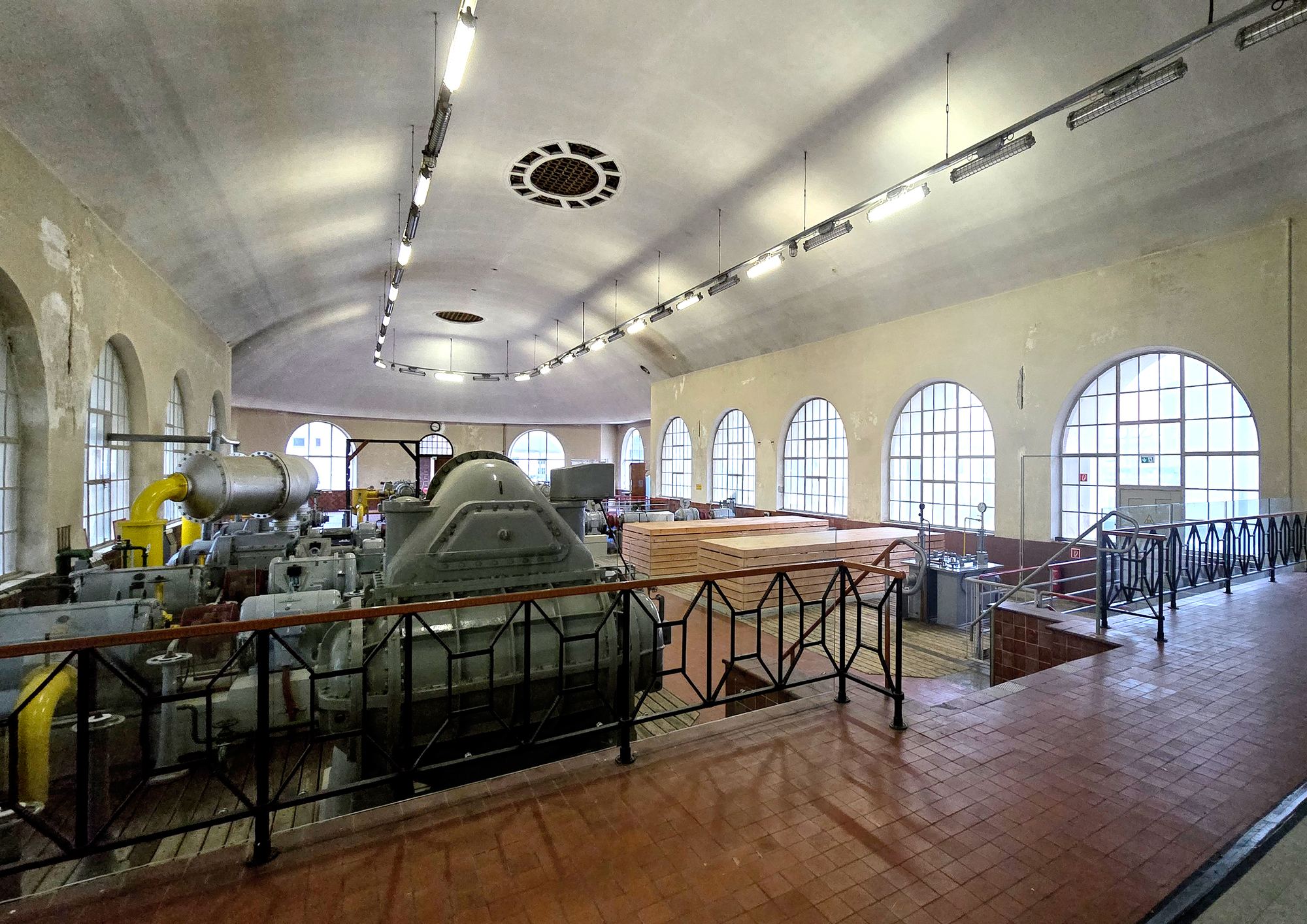
You get an everyday object and a simple task: make it better, make it smarter, or give it a new use. Then you spend three days asking unusual questions about it until a useful idea appears. At the end you build a model and present it to everyone.
This workshop was part of the Werkwoche, the international design week of the Faculty of Design at Technische Hochschule Augsburg (THA). Its name, “DenkMal neu”, is a play on words. Denk mal neu means “think again”, and Denkmal means monument. The workshop took place inside one: the old Augsburg gasworks.
The 2024 edition had one extra theme: how artificial intelligence changes the way we see everyday products.
Participants were put into teams at random. Our team chose a plain drinking bottle. We questioned it from every angle, found one real problem behind it (most people drink too little water) and built a model from modelling clay and LEGO. We called it TEKBOO. It won the vote with 14 votes.
The international design week of THA’s Faculty of Design, 11–15 November 2024, with workshops and talks on design, art, media and artificial intelligence.
THA’s Institute for Entrepreneurship and Innovation. It helps students and researchers turn ideas into projects or companies, and offers to keep supporting ideas from the workshop afterwards.
An Augsburg agency for communication and design, working in brand development, strategy, graphic design, web and photography. Two of its co-founders led the workshop. The agency has run this format at several editions of the Werkwoche.
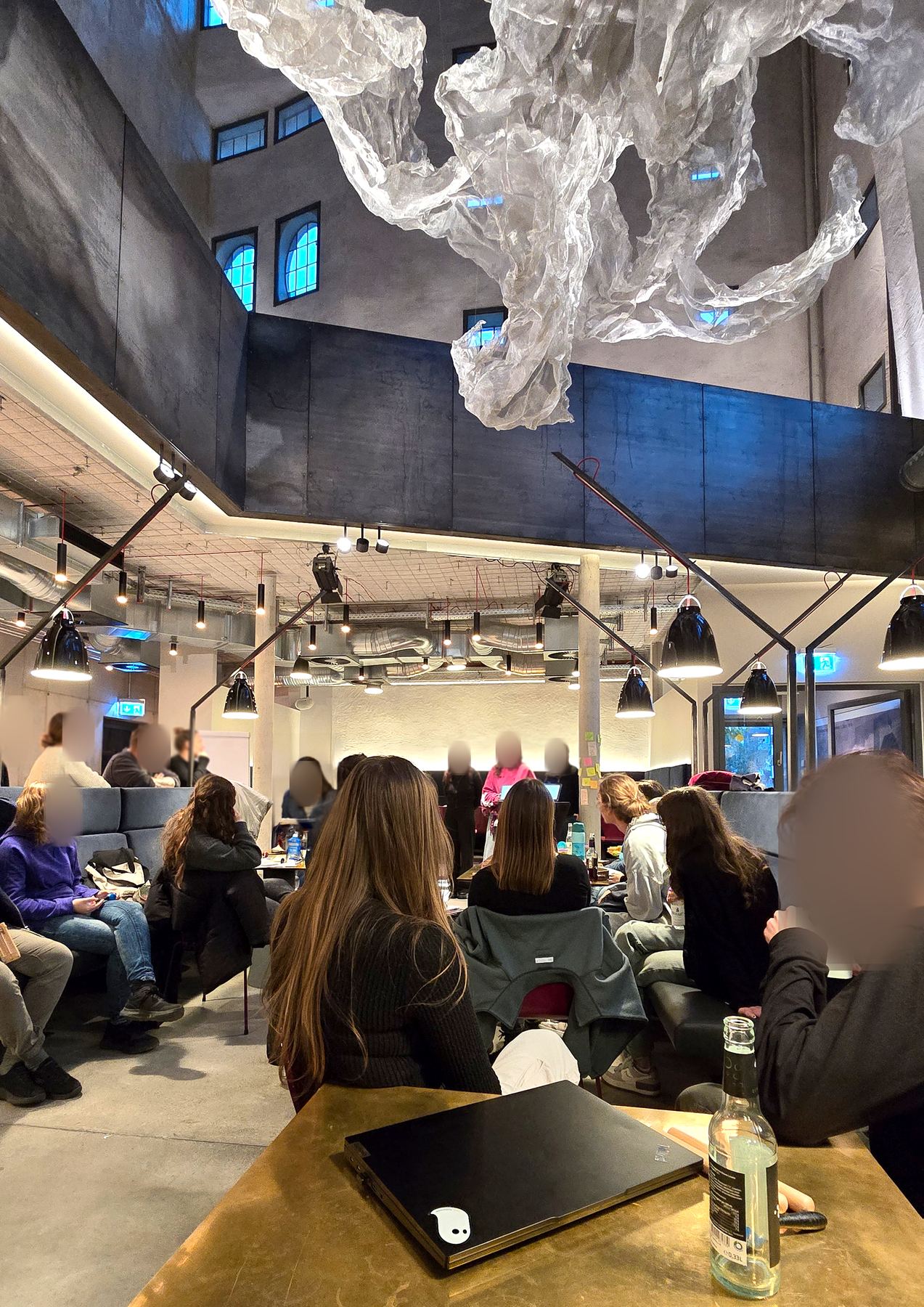
The workshop took place on the grounds of the old Augsburg gasworks, a listed industrial monument that no longer produces gas.
Today the site is the Gaswerk Kreativquartier, a creative quarter with studios, coworking space and event rooms. Our workroom was the Ofenhaus, the former furnace house.
The place fit the task. A building that once had one job and now has a new one is a good place to practise giving objects a second life.
The workshop ran in German. Drinks and snacks were provided, and everyone was asked to bring a creative tool of their own, such as a laptop, tablet or sketchbook.
A long table of ordinary things: an iron, an apple, a hammer, a bike helmet. Each team took one object. Ours was the dark drinking bottle with the black cap.
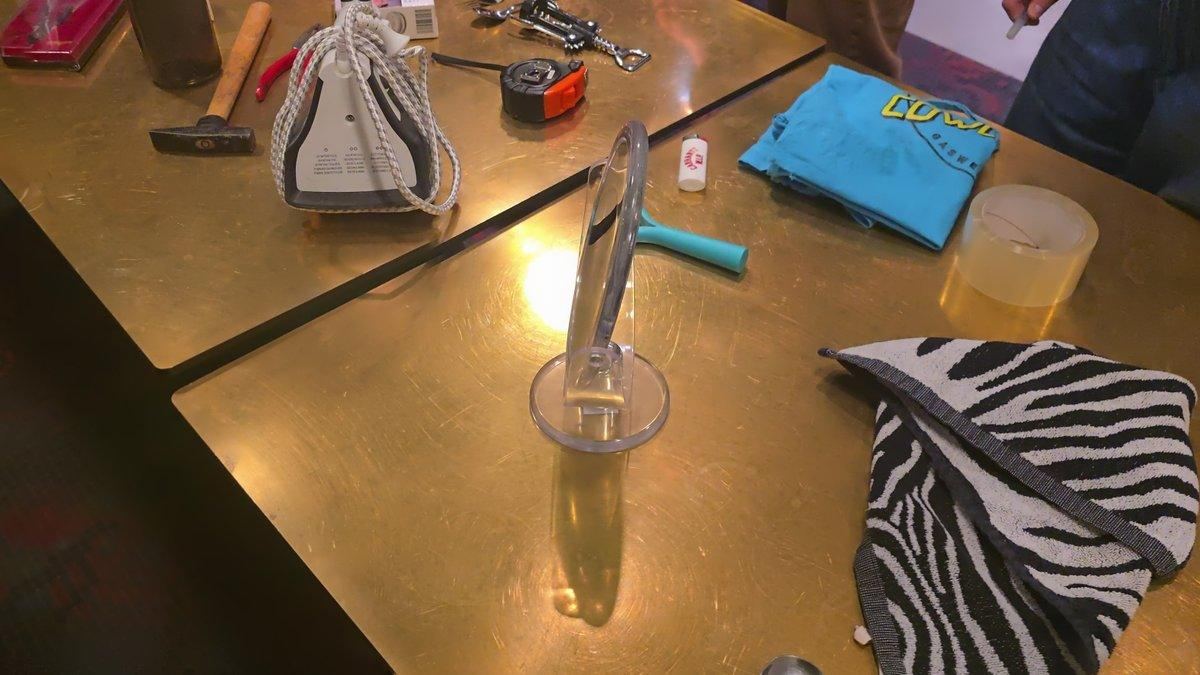
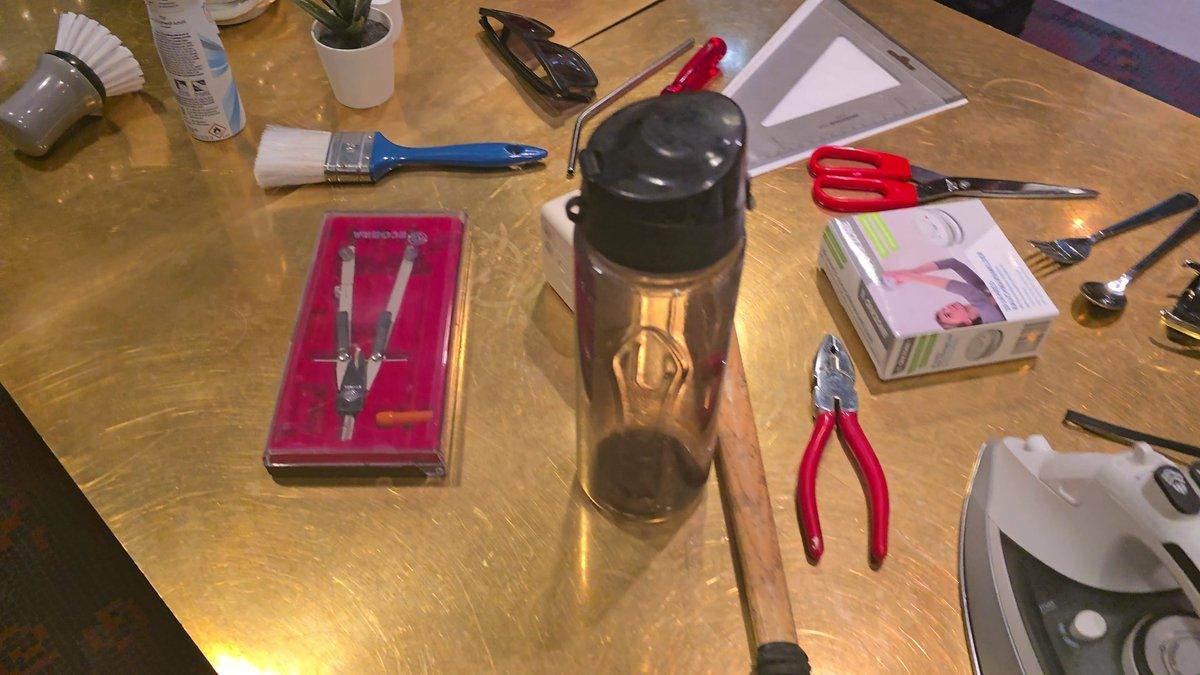
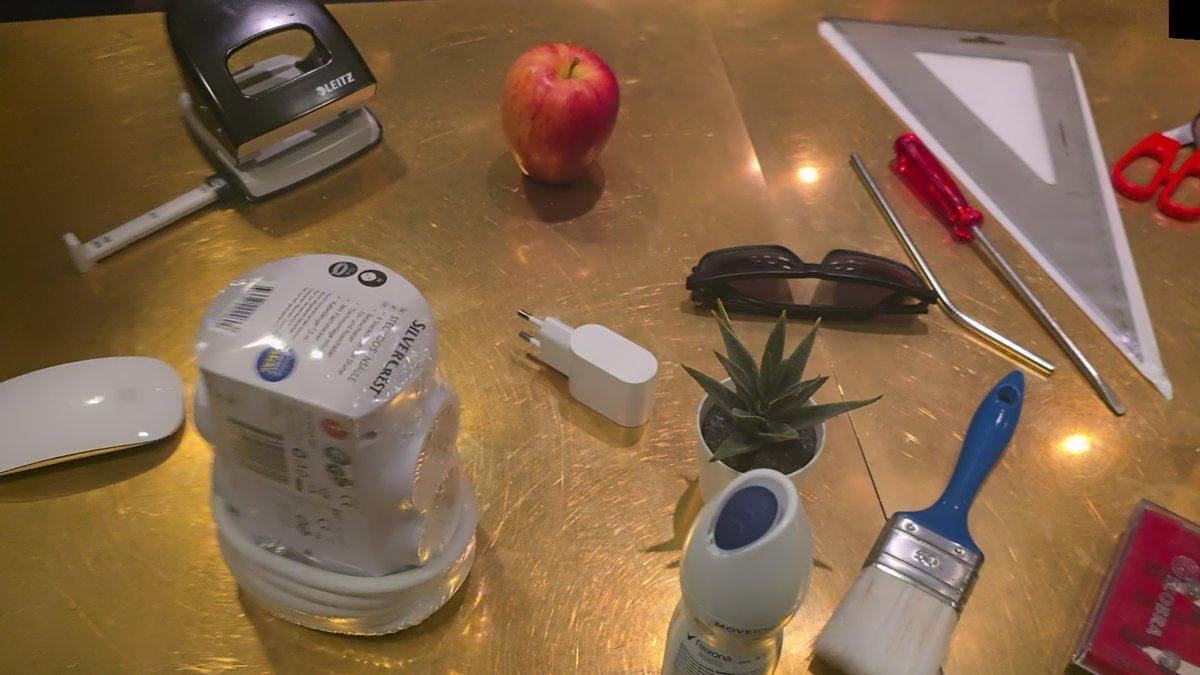
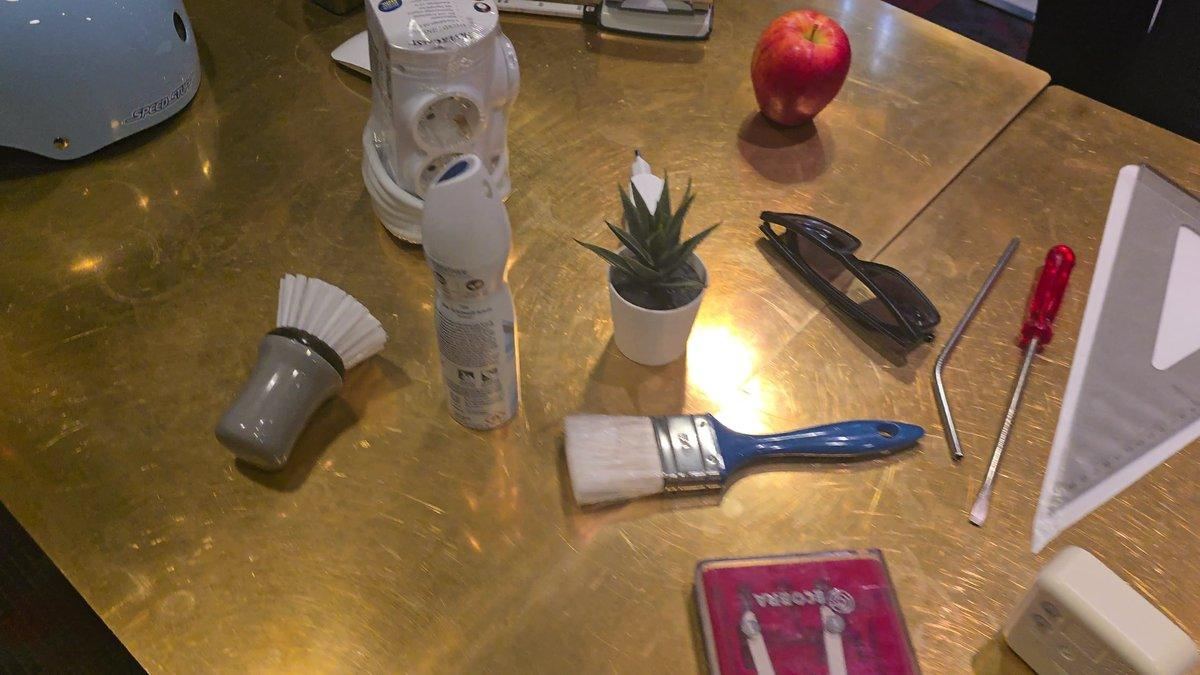
Stills from a short video of the object table, taken on day 1. Tap a number to see what it is.
Meet strangers, learn the methods, choose an object, and walk through a factory that got a second life.
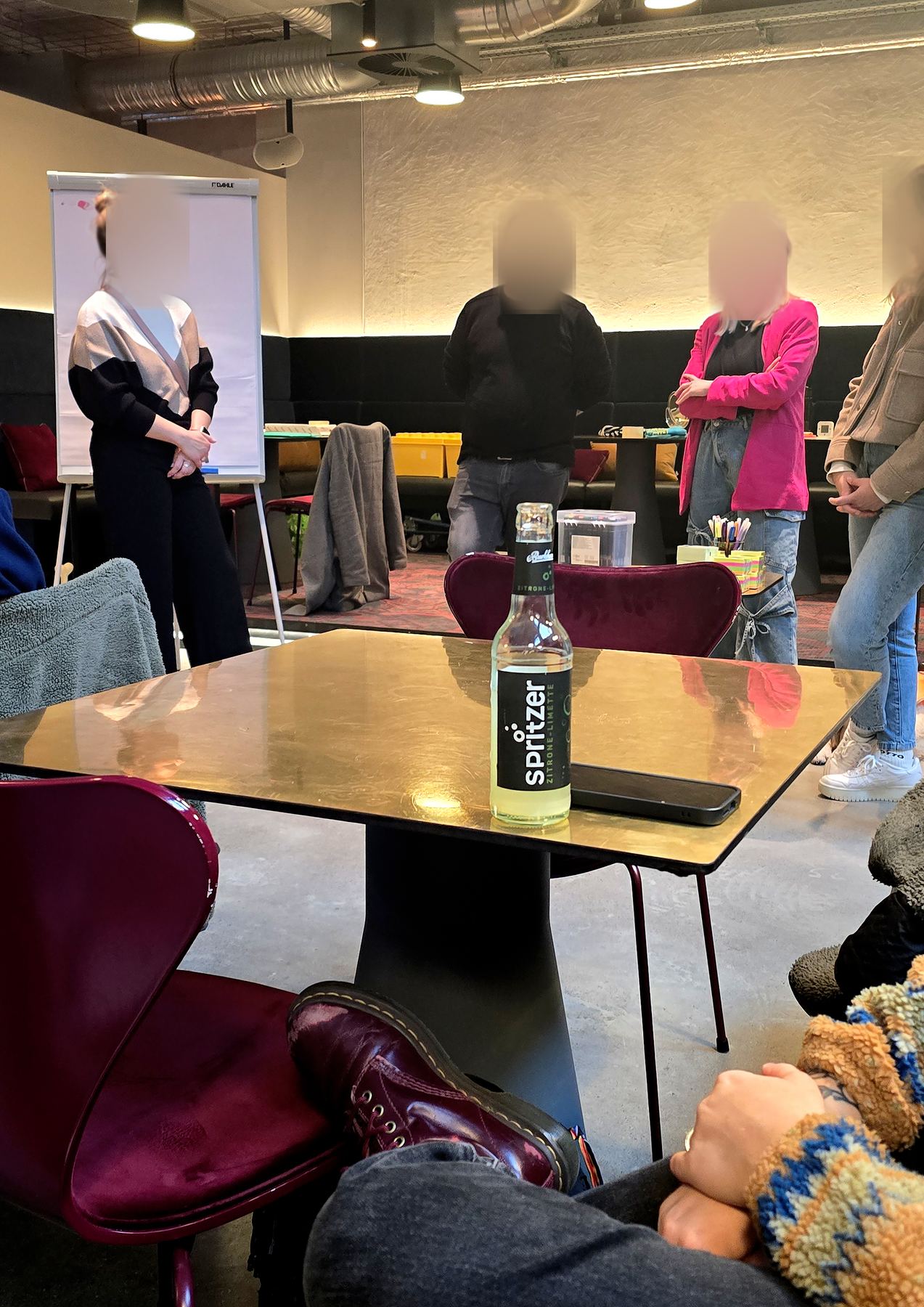
The workshop started in the Ofenhaus with a short welcome. The facilitators explained the plan for the three days and the theme of the year: artificial intelligence and how it changes the way we see products.
Nobody chose their own team. Participants were mixed at random, so most of us worked with people we had never met.
Each team then took one object from the table. The task was the same for everyone: keep the object, but make it better, make it smarter, or give it a new use. We took the bottle.
Before any ideas, the facilitators wrote the methods for the coming days on a flipchart. Each one is a way to stop thinking in habits:
Say every idea out loud. No judging yet.
Start with one word and branch out to related ideas.
Draw how a person uses the product, scene by scene.
Collect images and colours to define a look and feeling.
List everyone who deals with the product and how they connect.
Look at the object as a child, a critic, an animal or an alien.
Change one rule of reality and see what follows.
Combine the object with a random word to force new links.
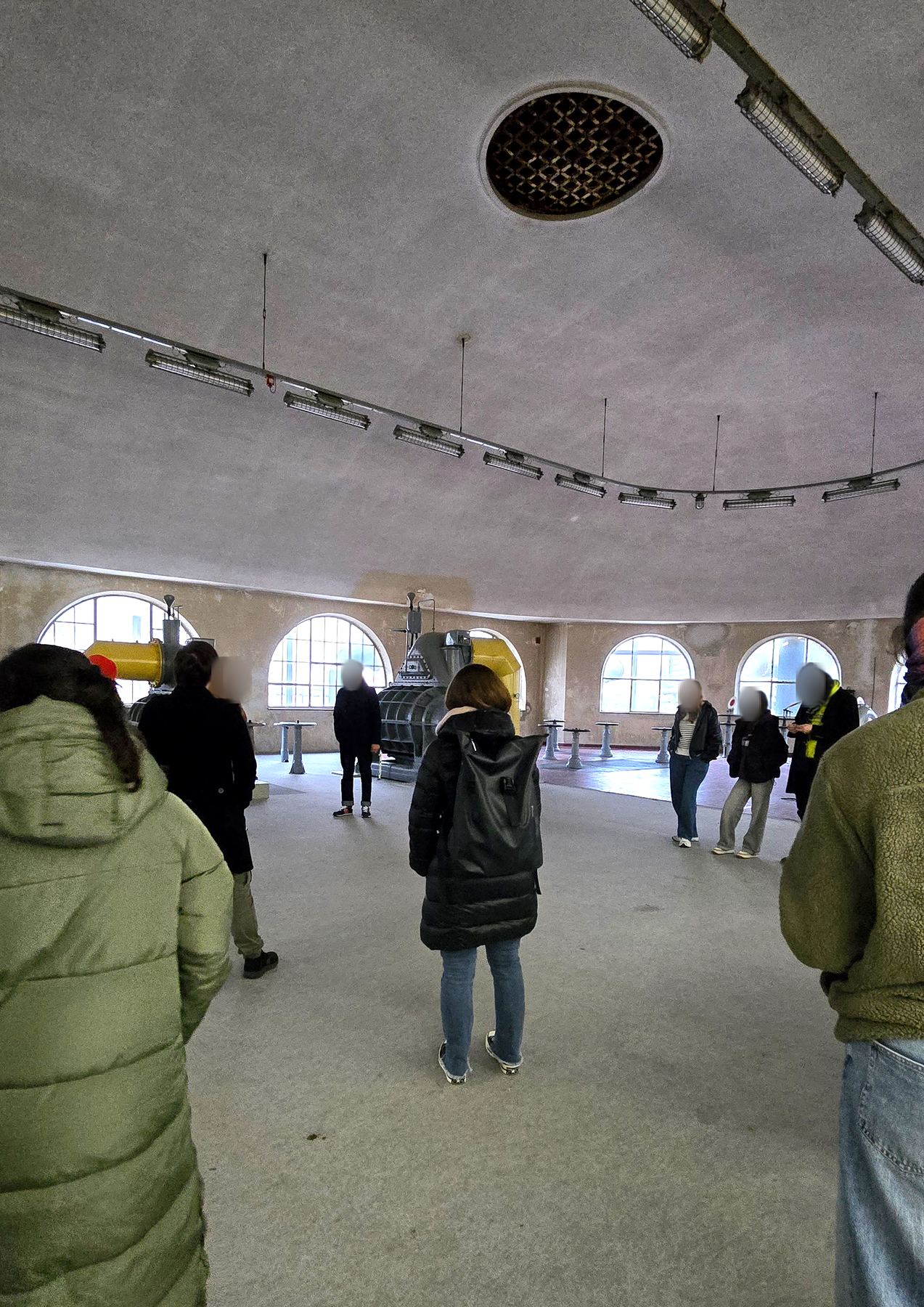
Later that day we left the room for a guided tour of the old gasworks: the machine hall, the old engines, iron railings and tall arched windows.
The tour set the tone. These halls were built for one purpose and are now used for something completely different. That was exactly our task for the bottle.
Every day had time for a break: coffee, snacks and conversations with people from the other teams.
Ten groups of questions, one wall of sticky notes, and slowly one idea that kept coming back.
Each team got a sheet called Teil 1 (Part 1) with ten groups of questions. Every group looks at the object from a different angle. Some questions are practical. Many are strange on purpose, for example: Which Harry Potter house would your object belong to? or What would it be like in 500 years? Strange questions push you past the first, obvious answers.
How it worked
The ten question groups · tap one to see the questions and our answers
Questions translated from the original German sheet. Answers copied from our sticky notes. The photos of our wall show groups 1 to 7.
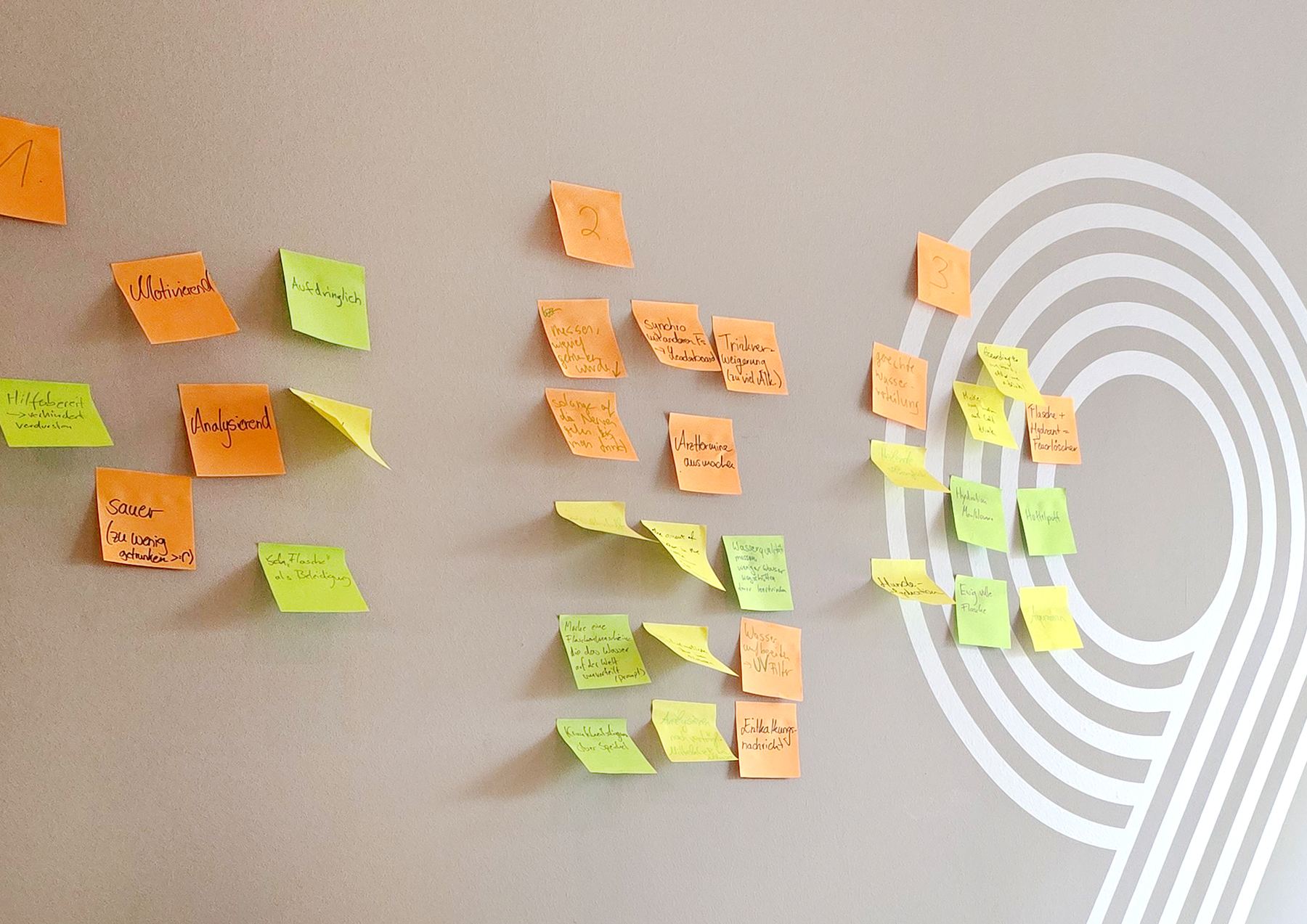
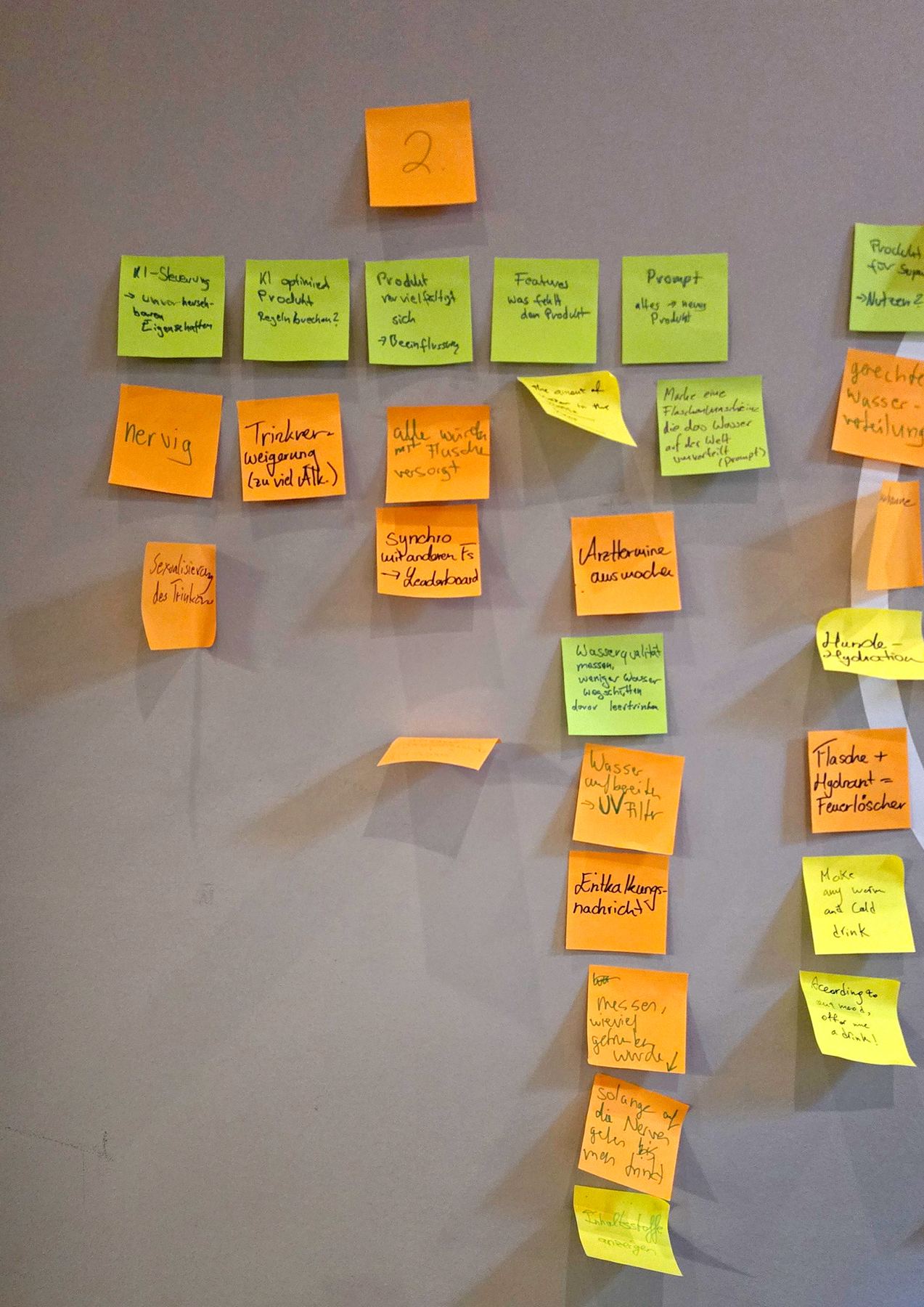
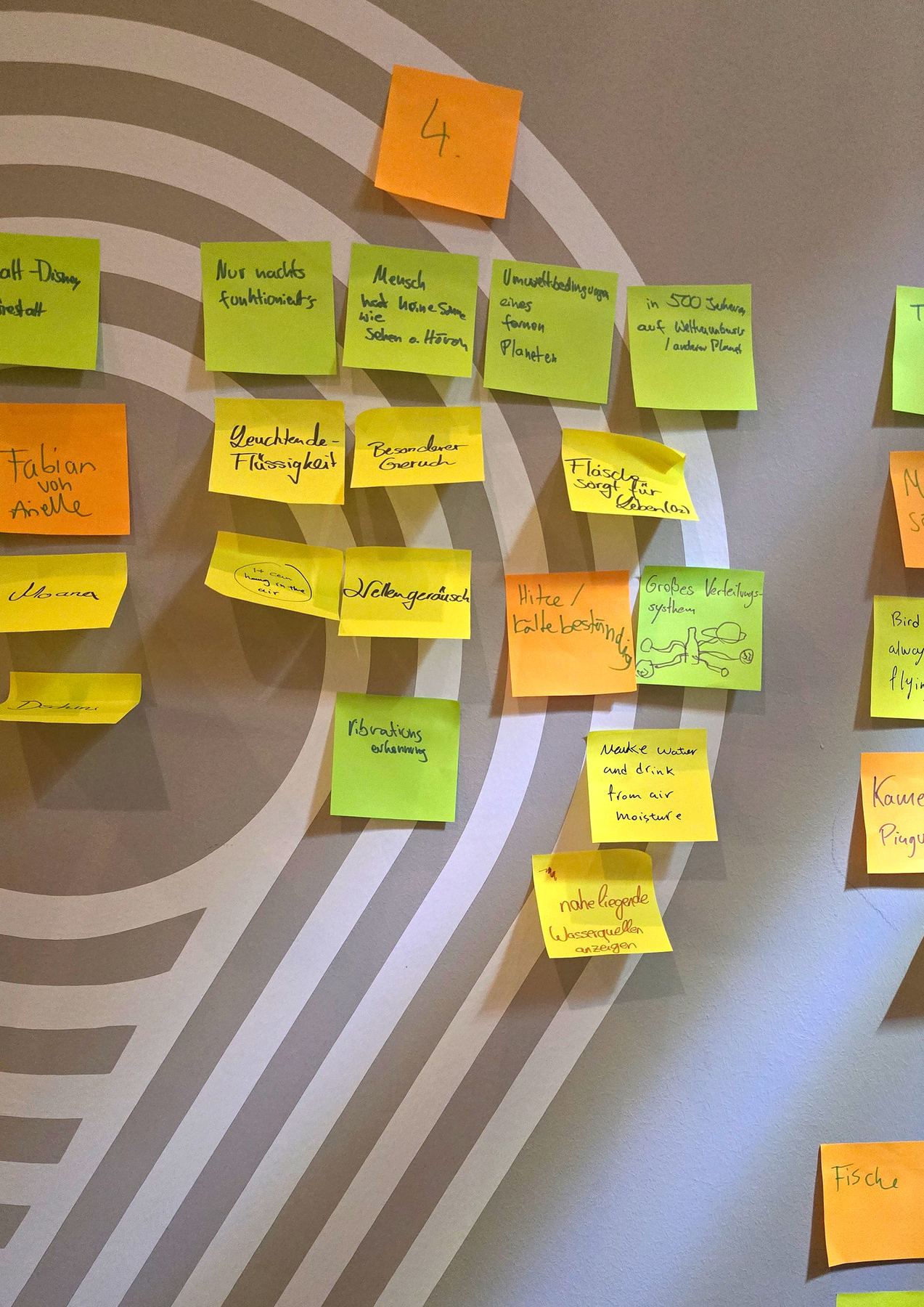
The photos of our wall show more than 70 ideas on sticky notes, spread over seven of the ten question groups. Some were practical, like a UV filter or a reminder to descale. Many were playful, like a bottle that is a mermaid or a bottle that floats in the air.
When we read all the notes together, one theme came up again and again: the bottle as a character. It was motivating, pushy, comforting, sour when you drink too little. Under the fantasy sat a simple, real problem: many people forget to drink enough water. We chose this direction and made the bottle’s personality the solution.
No feature was invented at the end. Each one goes back to notes on the wall, often from the strangest questions. Tap a row to follow one idea.
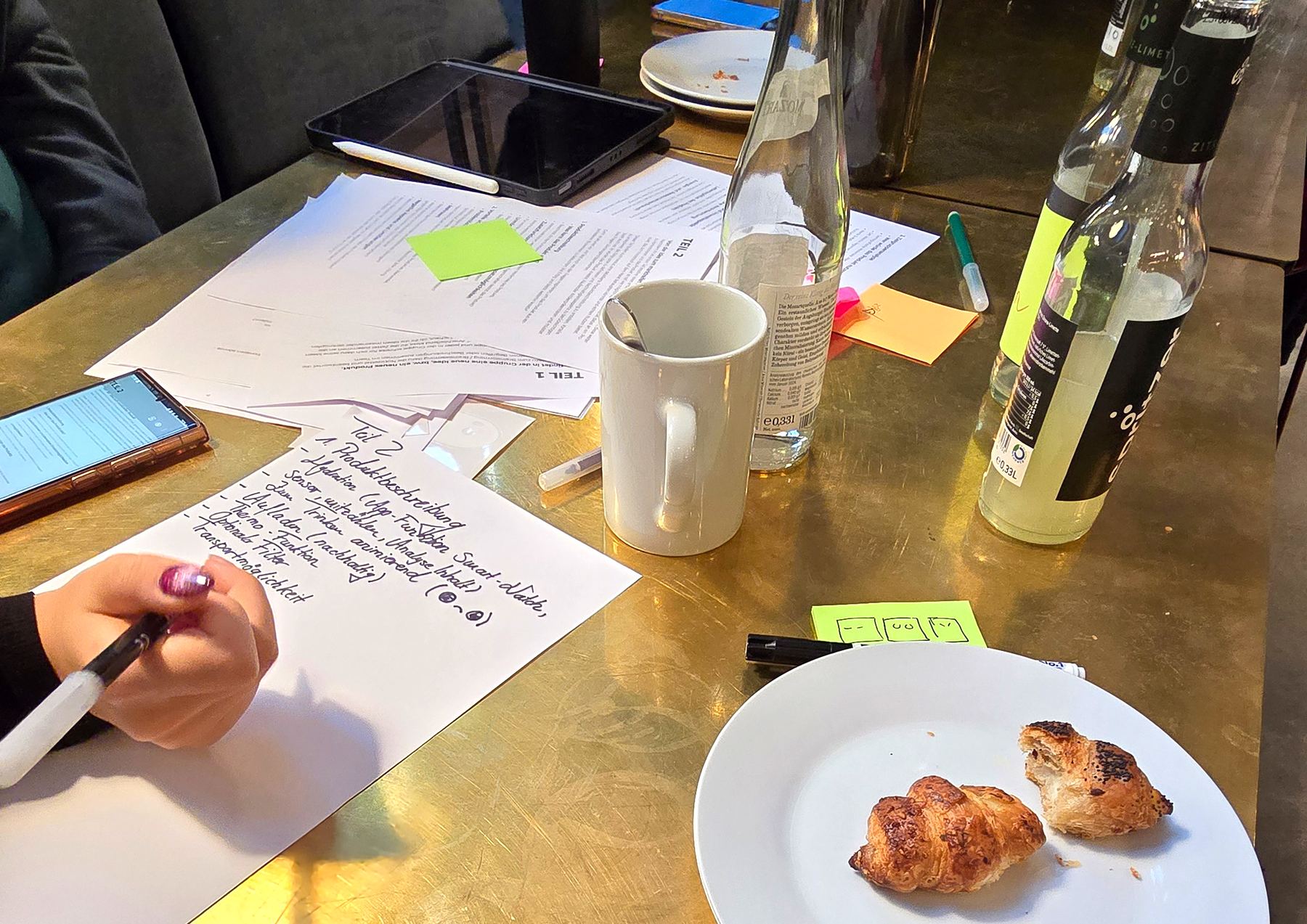
A second sheet, Teil 2, asked us to be realistic. Describe the product in detail. Name its strengths and its weak points. Define who would buy it and who would refuse it. Check if it could be sustainable. The sheet suggested imagining that we had to defend the product in front of an investor, a buyer and a critic.
We wrote our answers by hand. This is a clean version of them:
People drink too little water.
Linked topics we noted: health, motivation and loneliness.
Give the bottle a personality.
A bottle with a face that reacts and motivates you, so drinking becomes a small relationship instead of a task.
Joy, enthusiasm and an emotional bond.
Paper, clay and LEGO. By the afternoon the bottle had a face, a name and an audience to convince.
The last sheet, Teil 3, turned the concept into something you can hold. It listed seven steps:
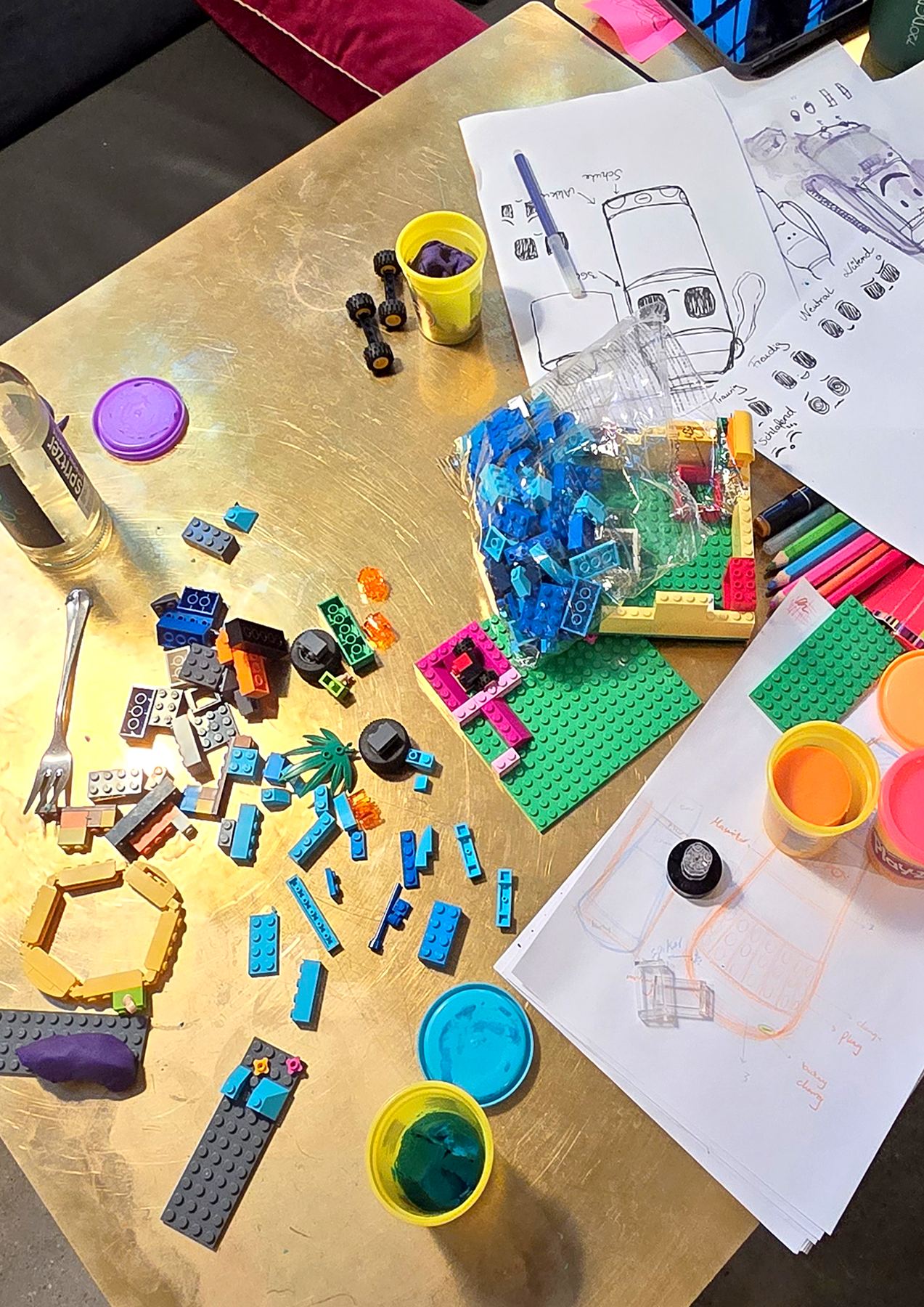
The face became the heart of the design. We sketched the bottle with eyes and drew four moods: sad, happy, neutral and angry. Drink regularly and the bottle is happy. Forget it and it gets grumpy. The idea came straight from the wall, where one note read “sour (drank too little) >:(”.
Other sketches showed a 360° display, a fill-level display, a filter, a speaker and a charging point. We chose the name TEKBOO.
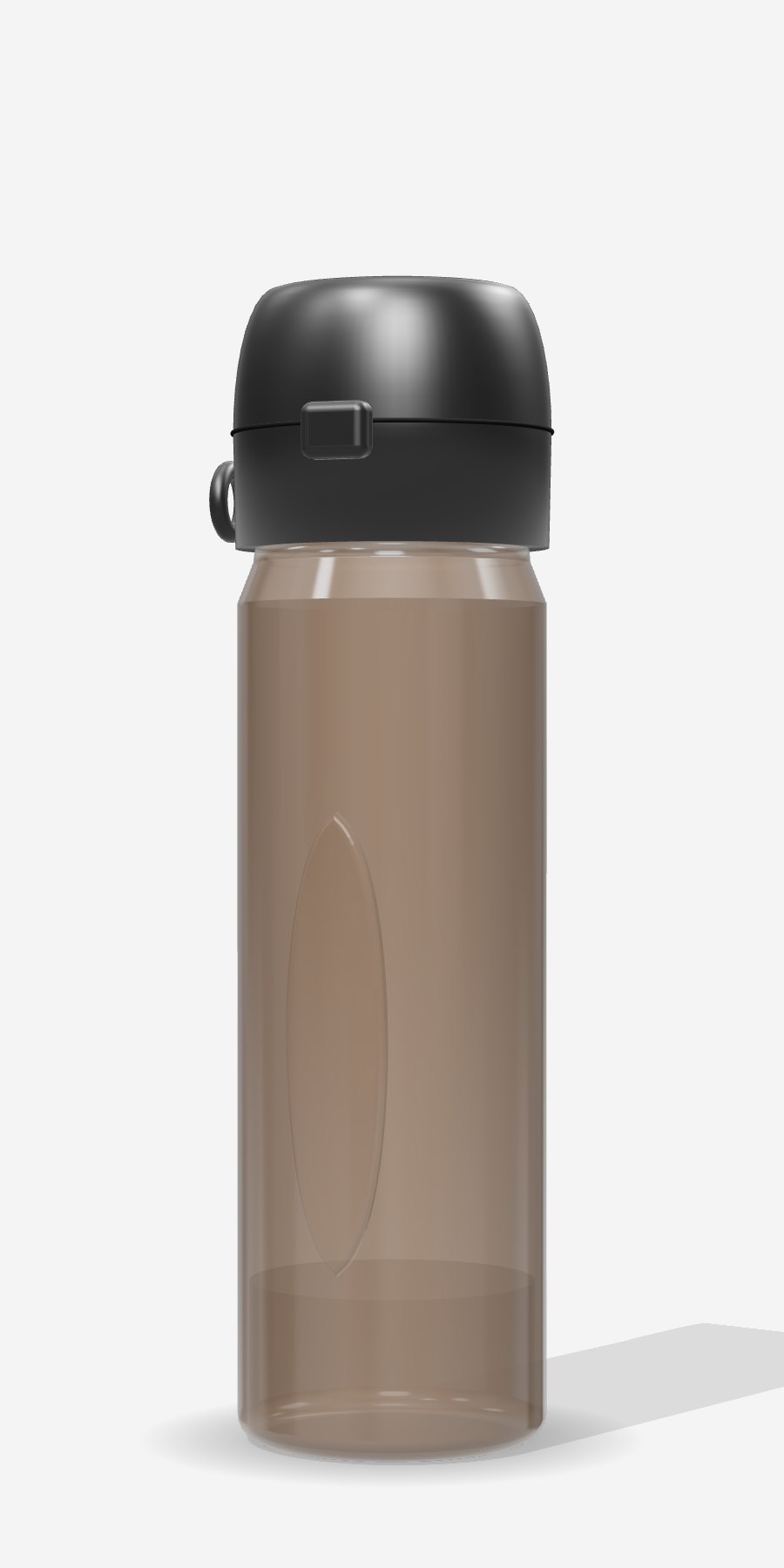
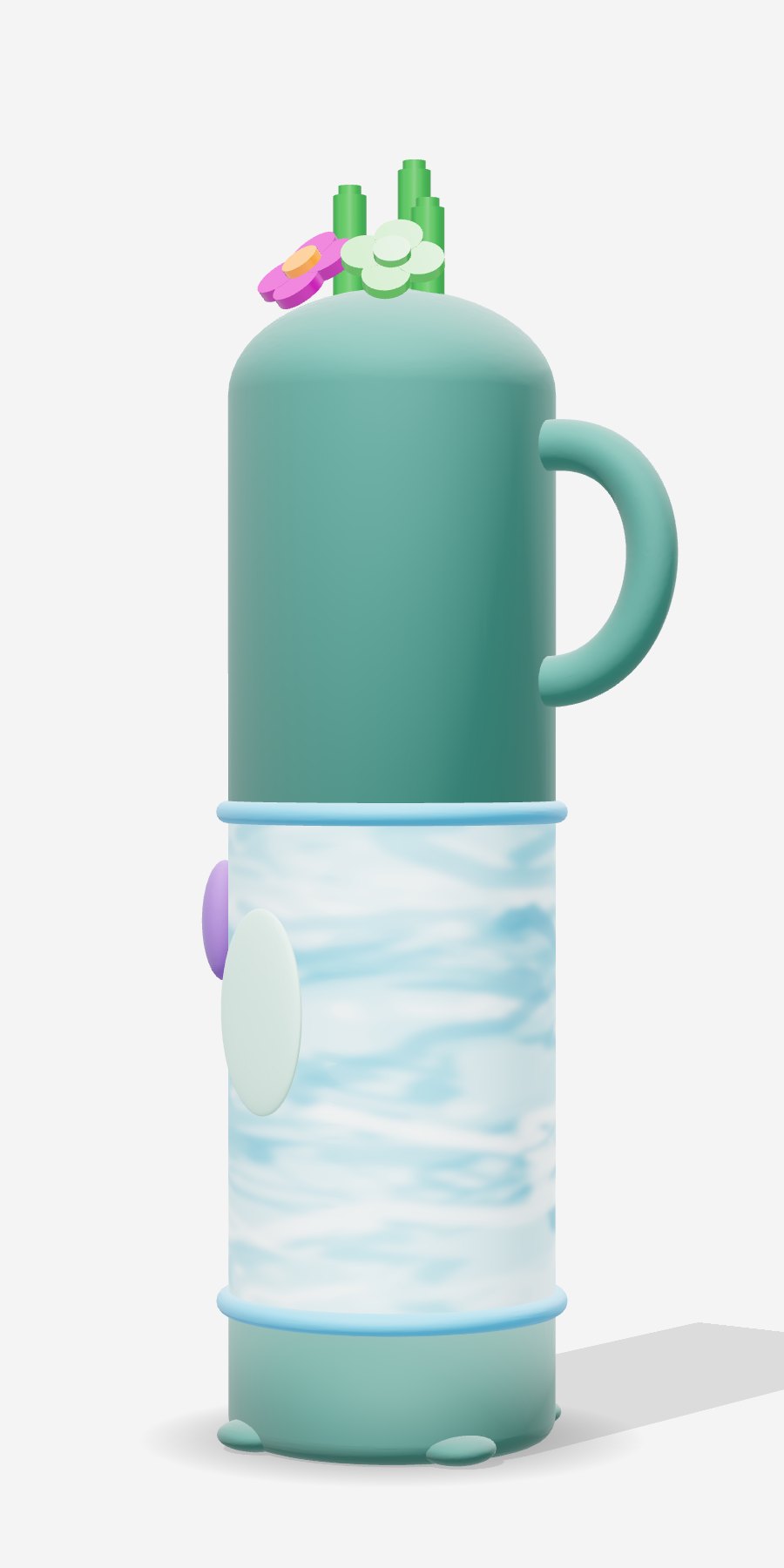
Then we built it. We covered the real bottle from the object table with teal and blue modelling clay, added a handle and small feet, and put little LEGO plants and flowers on top. Each team member took one part of the build. Drag the slider to compare.
 BeforeAfter
Before
A plain, dark, see-through drinking bottle with a black flip-top cap. One object among many on the table.
After
The same bottle as TEKBOO, the clay and LEGO prototype. Clay covers the body and the cap: a teal top with a handle, a marbled blue middle and small feet. LEGO plants and flowers sit on top.
3D illustrations based on our photos of the real bottle and the clay model. Both are shown at the same scale, from the same angle.
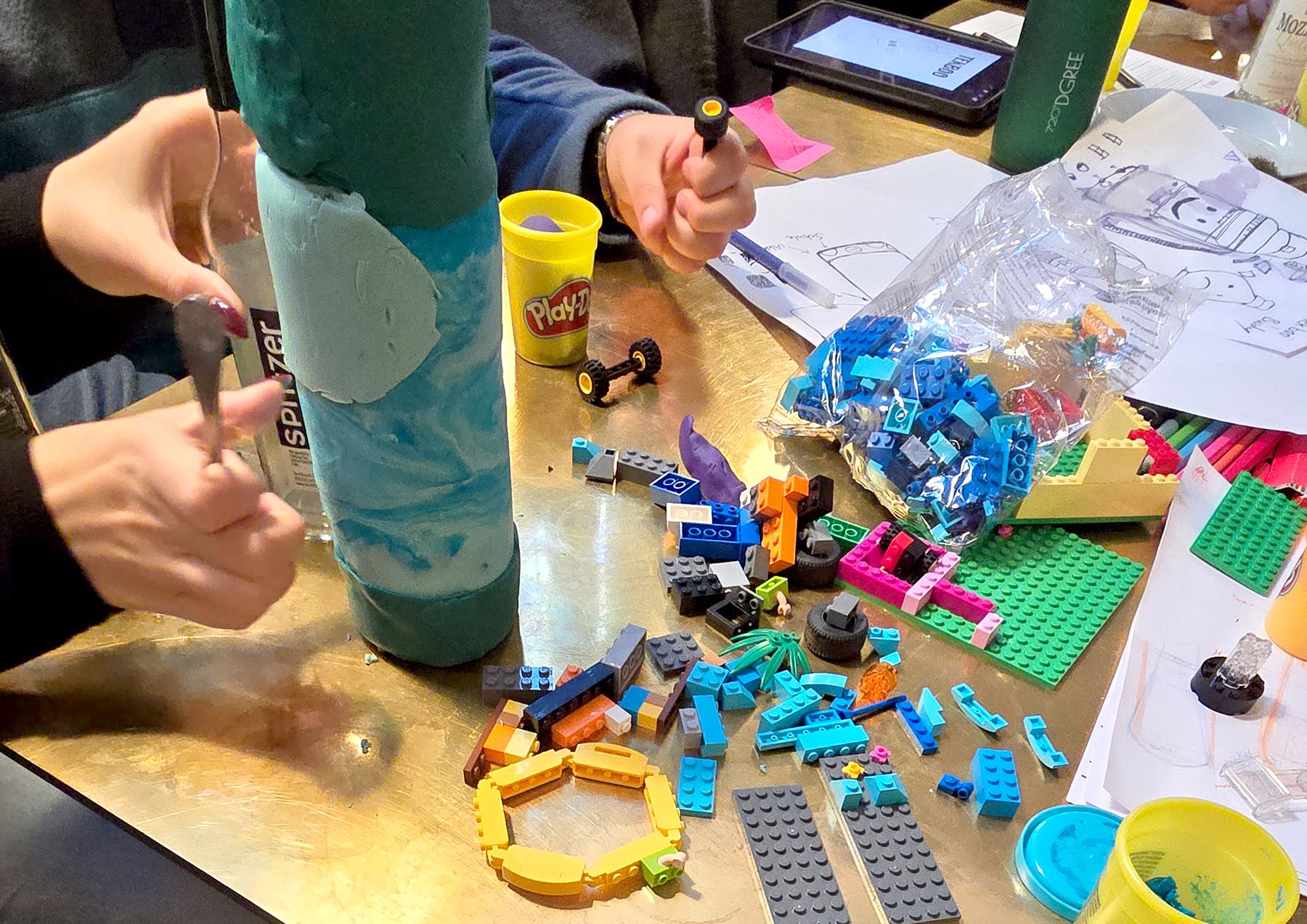
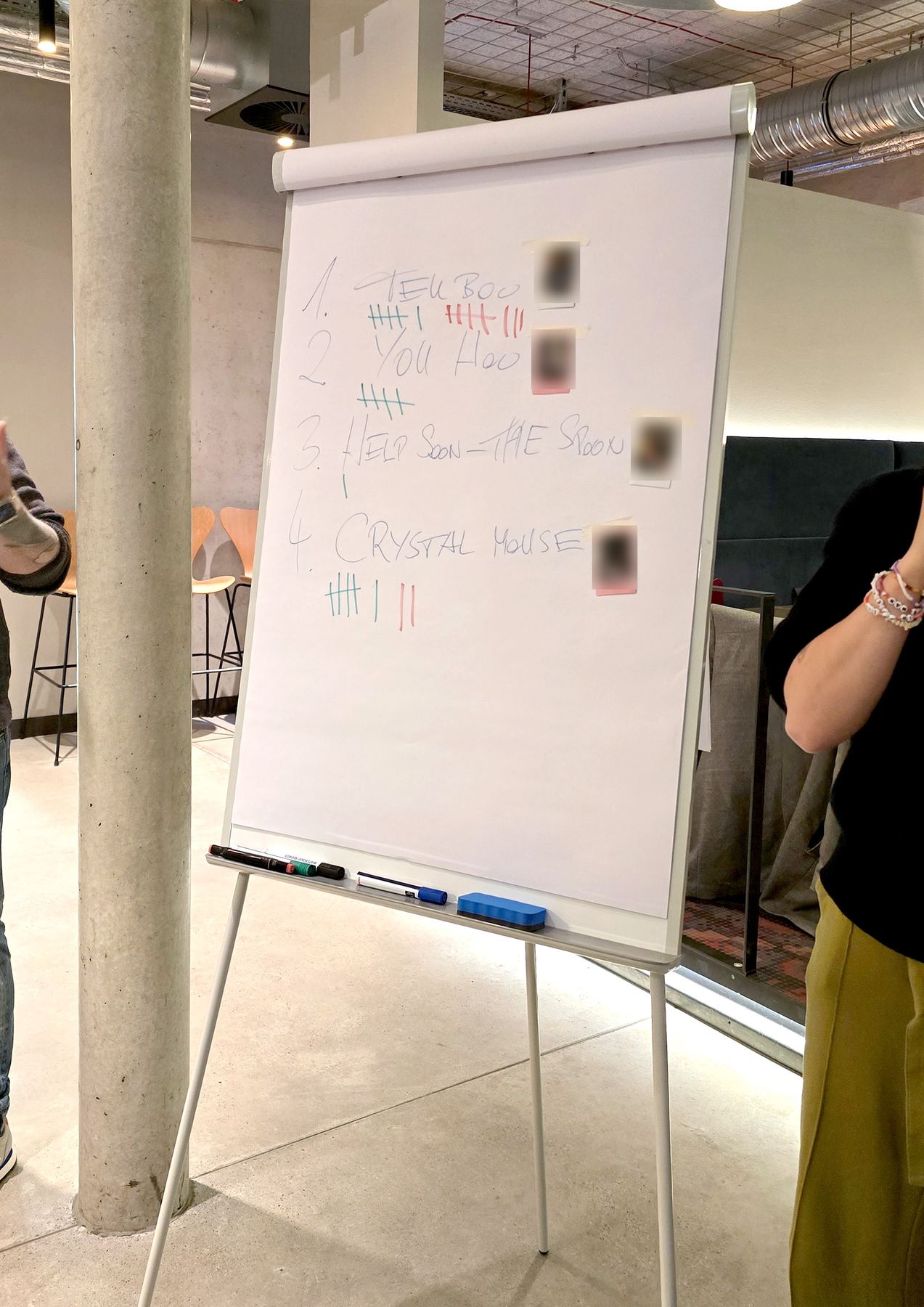
Every team presented its idea to the whole group. Then all participants voted with tally marks on a flipchart.
Votes counted from the tally marks on the flipchart.
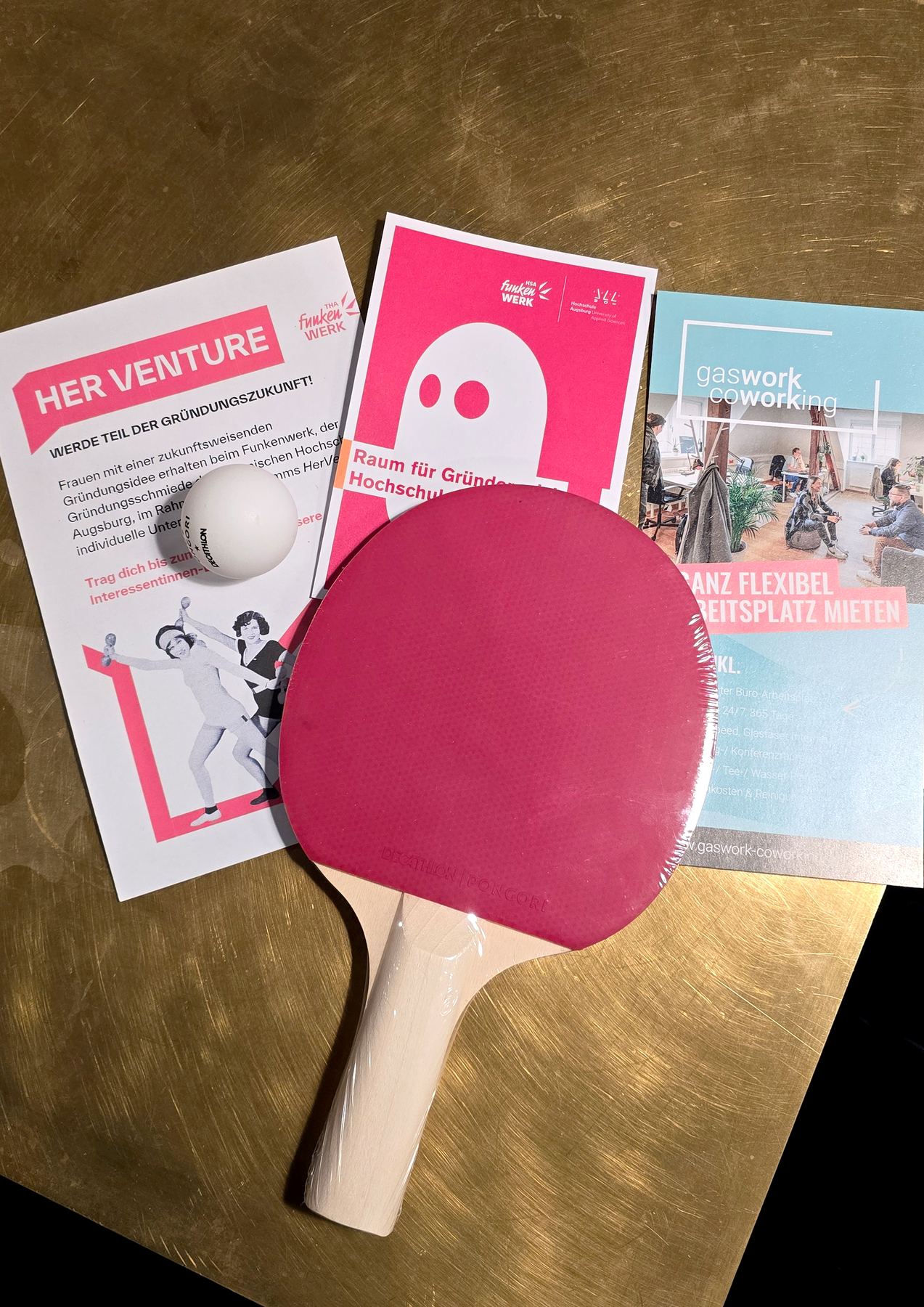
TEKBOO received 14 votes, as many as the other three teams together. The winning team got a small souvenir: a table-tennis paddle and ball, plus flyers from THA_Funkenwerk and the gaswork coworking space.
A real problem. Behind the playful face is something almost everyone knows: forgetting to drink water.
One clear character. A bottle with moods is easy to picture. The four faces explain the product without many words.
Honest limits. We named the price, the battery, the risk of dependency and who would never buy it. That makes a concept believable.
This was teamwork from the first sticky note to the last vote.
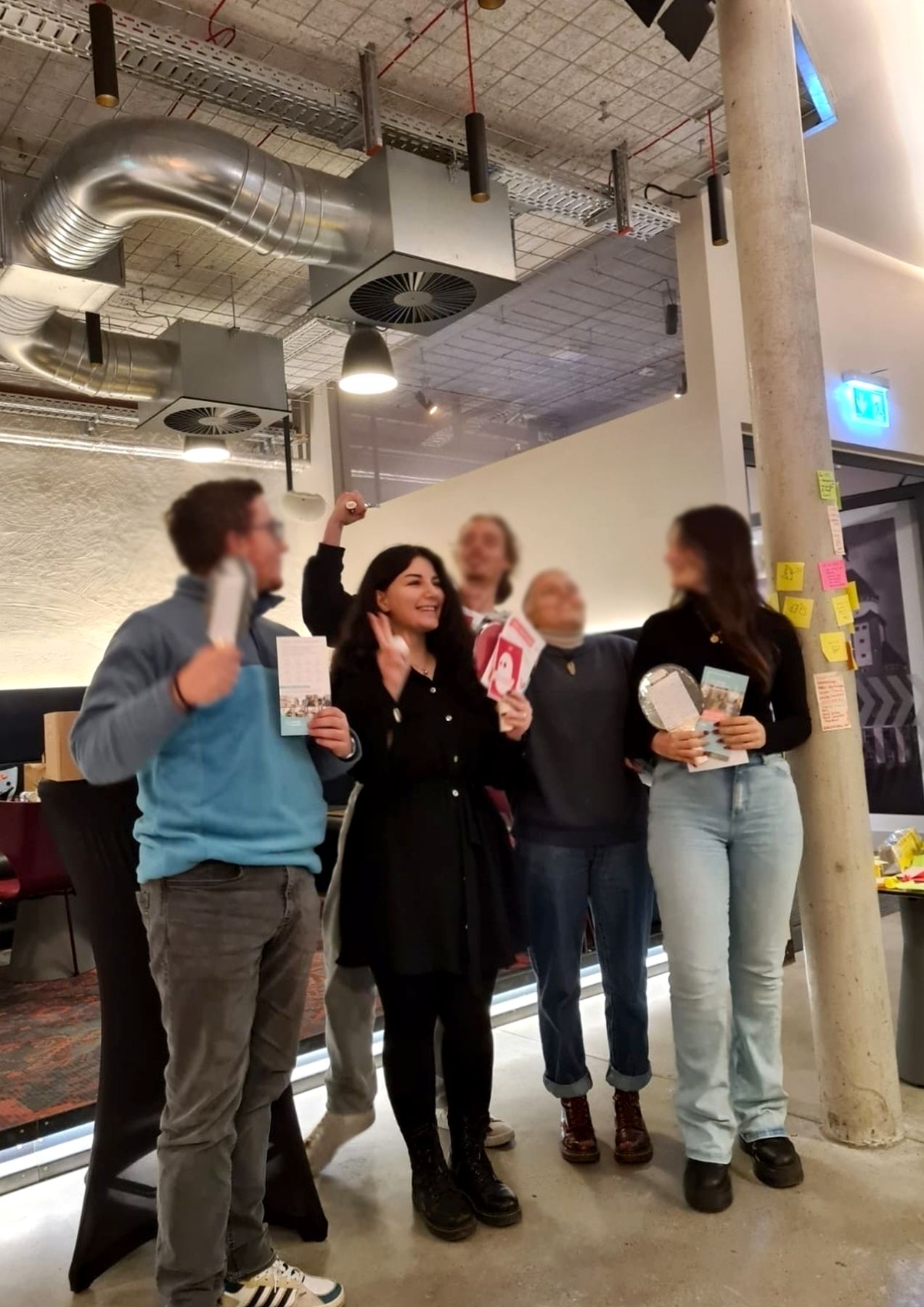
Nothing in this case study is the work of one person. All five of us wrote notes for every question, read them out and discussed them. We made the decisions together, for example to focus on drinking water and to give the bottle moods.
In the practical part we split the work. Each person took one part of the production. Then we put the parts together into one model and one presentation.
The workshop ran in German, and our notes switch between German and English.
The workshop gave me a way of thinking I can repeat. These are the rules I took from it.
Many notes on our wall were useless on their own. Together they pointed in one direction. Collecting ideas and choosing ideas are two separate steps.
Questions about the bottle’s personality and mood sounded like a game. They produced our strongest feature: a bottle with feelings.
No single note won. The idea appeared when we saw the same theme in several question groups.
The bottle could have become a water cannon or a genie. We kept the character and tied it to a real problem: people forget to drink.
Our own notes called the bottle “annoying” and “pushy”. We turned that into a design rule: the bottle has to respect personal limits.
A sketch or a rough model shows an idea faster than a long discussion. Our clay model made TEKBOO understandable at a glance.
Five people who had just met, three days. It worked because ideas were shared openly and decisions were made as a group. Then each person took one part of the build.
Each skill below is tied to something we actually did.
| Skill | What we did | When |
|---|---|---|
| Structured idea generation | Worked through the question groups with methods like “What if…?”, change of perspective and trigger words. Produced several dozen sticky-note ideas for one object. | Day 2 |
| Finding the core idea | Read the whole wall, spotted the theme that kept coming back (the bottle as a character) and connected it to one everyday problem. | Day 2 |
| User and market thinking | Described the target group by age, income, values and lifestyle. Named who would reject the product and why. | Day 2 |
| Critical evaluation | Listed weak points openly: price, battery, dependency, weight, cleaning. | Day 2 |
| Sustainability thinking | Checked materials, recycling, replaceable parts and energy use before building. | Day 2 |
| Rapid prototyping | Went from sketches to a physical clay and LEGO model within one day. | Day 3 |
| Naming and visual identity | Chose a name, colours and four facial expressions that carry the concept. | Day 3 |
| Presenting | Presented the concept to all teams. Won the vote with 14 votes. | Day 3 |
| Teamwork with strangers | Worked in a random team and reached shared decisions within three days, in German. | Day 1–3 |